Article: Rice Milk Soap: The Batch That Turns Into Porridge Before It Becomes Soap

Rice Milk Soap: The Batch That Turns Into Porridge Before It Becomes Soap
There are moments in soapmaking when you look into the bowl and think:
This cannot possibly be right.
Our Rice Milk Bar has one of those moments.
When sodium hydroxide is added to concentrated frozen rice milk, what starts as a liquid can suddenly thicken into something resembling paste-like porridge. The first time it happens, it is pretty alarming.
Thankfully, that strange bowl of porridge eventually becomes one of our loveliest soap bars.
But why rice milk in the first place?

Why Rice Milk?
Goat milk soap is hugely popular, and we can understand why people are drawn to milk soaps.
But when we decided that My Naked Bar would make only vegan soap bars, goat milk was naturally off the table. That got us curious about plant-based milks instead.
And rice felt particularly familiar.
If you grew up washing rice, you probably know that slightly silky, starchy feeling the water leaves on your hands. Rice water also has a long history in East Asian beauty rituals, so exploring rice as an ingredient felt both interesting and strangely close to home.
Eventually, that curiosity became our Rice Milk Bar.

How We Make the Rice Milk
We start with organic brown rice. It gets washed, soaked and cooked until soft, then blended into a thick rice milk.
https://cdn.shopify.com/videos/c/o/v/32fc29cfb6c44c90af399acf99ce31fa.mov
And then comes probably the least glamorous part of the process: straining it.

The mixture can be surprisingly thick, so getting the consistency we want takes patience. Once ready, the rice milk is portioned and frozen.

Only then do we get to the actual soapmaking.
Did I Ruin It?
This is where things get interesting.
Cold-process soapmaking requires sodium hydroxide. When we gradually add it to the frozen rice milk, the mixture starts to change. And depending on how concentrated that particular batch of rice milk is, it can change a lot.
Instead of remaining liquid, it can become thick enough to look almost solid.
Think: paste-like porridge.
If you are seeing it for the first time, there is definitely a moment of: Did I just ruin the whole batch?
Nope.
It is simply one of the quirks we have learnt to expect when working with rice milk. We watch the temperature, work carefully and make sure everything is properly incorporated before moving on.
Every ingredient behaves a little differently. Rice milk just happens to be rather dramatic about it.
From Rice Milk to Cold-Process Soap
Once the rice milk mixture is incorporated with the oils, the process starts looking more familiar.
The soap is blended, poured into moulds and left to set. It is then unmoulded, cut and stamped before going through the usual cold-process curing period.

So that neat little Rice Milk Bar started with something rather less elegant: a pot of brown rice, a lot of straining and one fairly alarming bowl of porridge.
Why We Still Make It This Way
Could we make things easier? Probably.
But one reason I still enjoy soapmaking is that ingredients do not behave exactly the same way every single time.
Temperature changes. Humidity changes. Ingredients vary. And even something we have made repeatedly can still surprise us.
Rice Milk is a perfect example.
It starts with an ingredient we know from our kitchens, behaves rather strangely halfway through, and somehow ends up as a soap bar.
That little bit of unpredictability is part of what keeps handmade soapmaking interesting.
One Last Detail
Our Rice Milk and Lavender Oatmeal bars are both naturally quite neutral in colour, so we wanted the Rice Milk Bar to have a look of its own.

That is why we texture the top differently.
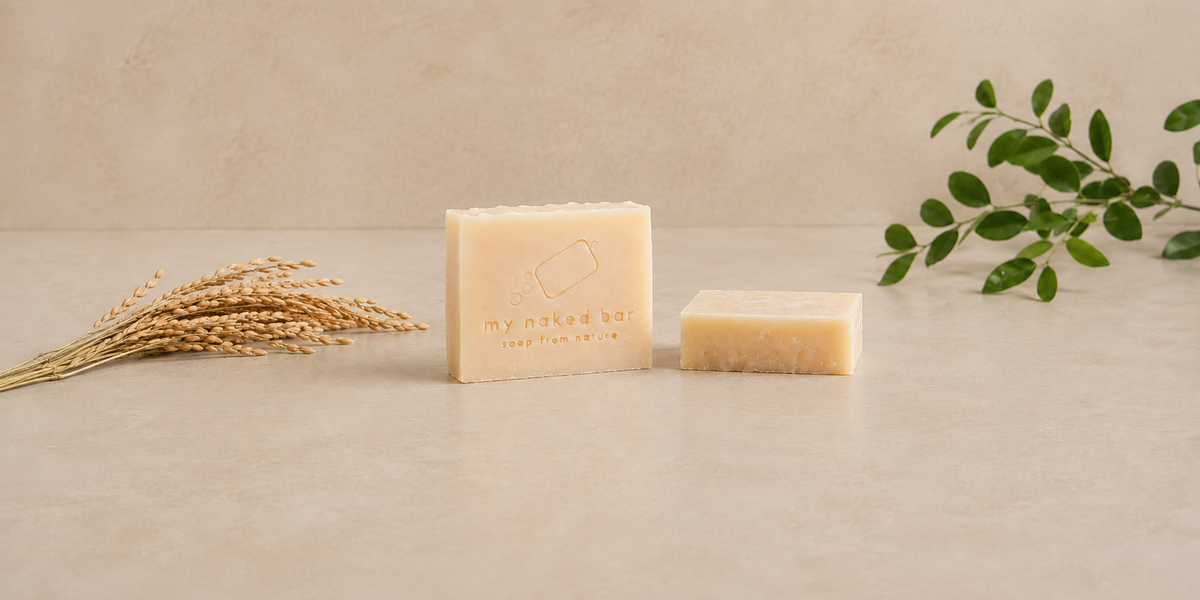
And if you look closely, the texture is meant to mimic the thick, porridge-like stage the rice milk goes through during soapmaking.
It started as a practical way to tell the two bars apart. Over time, it became a tiny visual reminder of the strange bit in the middle of the process.
Curious about the process? → How Cold-Process Soap Is Made
Curious about the finished bar? → Meet our Rice Milk Bar